
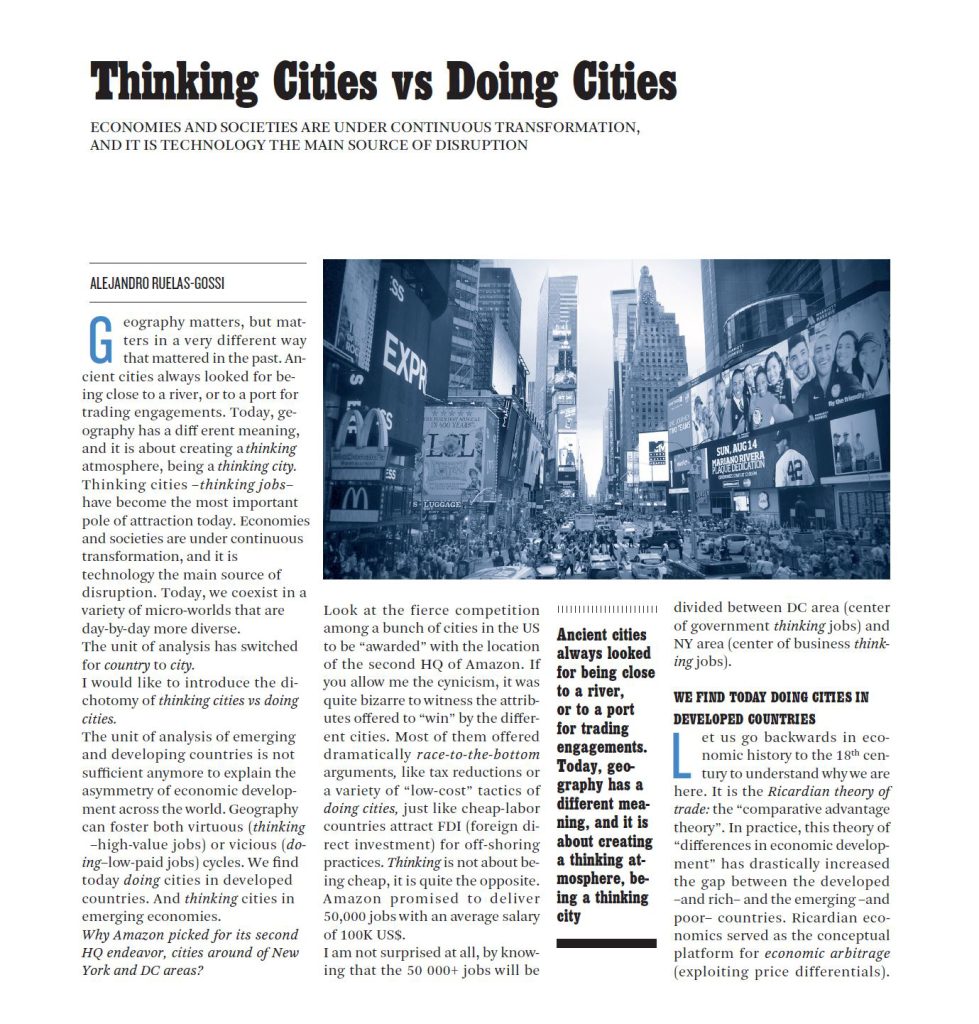
Geography matters, but matters in a very different way that mattered in the past. Ancient cities always looked for being close to a river, or to a port for trading engagements. Today, geography has a diff erent meaning, and it is about creating a thinking atmosphere, being a thinking city. Thinking cities –thinking jobs– have become the most important pole of attraction today. Economies and societies are under continuous transformation, and it is technology the main source of disruption. Today, we coexist in a variety of micro-worlds that are day-by-day more diverse. The unit of analysis has switched for country to city. I would like to introduce the dichotomy of thinking cities vs doing cities. The unit of analysis of emerging and developing countries is not sufficient anymore to explain the asymmetry of economic development across the world. Geography can foster both virtuous (thinking –high-value jobs) or vicious (doing–low-paid jobs) cycles. We find today doing cities in developed countries. And thinking cities in emerging economies. Why Amazon picked for its second HQ endeavor, cities around of New York and DC areas?
Look at the fierce competition among a bunch of cities in the US to be “awarded” with the location of the second HQ of Amazon. If you allow me the cynicism, it was quite bizarre to witness the attributes off ered to “win” by the diff erent cities. Most of them offered dramatically race-to-the-bottom arguments, like tax reductions or a variety of “low-cost” tactics of doing cities, just like cheap-labor countries attract FDI (foreign direct investment) for off-shoring practices. Thinking is not about being cheap, it is quite the opposite. Amazon promised to deliver 50,000 jobs with an average salary of 100K US$. I am not surprised at all, by knowing that the 50 000+ jobs will be divided between DC area (center of government thinking jobs) and NY area (center of business thinking jobs). WE FIND TODAY DOING CITIES IN DEVELOPED COUNTRIES L et us go backwards in economic history to the 18th century to understand why we are here. It is the Ricardian theory of trade: the “comparative advantage theory”. In practice, this theory of “diff erences in economic development” has drastically increased the gap between the developed –and rich– and the emerging –and poor– countries. Ricardian economics served as the conceptual platform for economic arbitrage (exploiting price differentials).
And eventually, for instance, the proliferation of the USA off -shoring practices. According to this stream of thought, the widespread paradigm among policymakers and academics that study the process of how developing countries catch-up with developed countries is that, essentially, the way forward for developing countries is to integrate into the global value chains, mostly by carrying out low value-added activities within the chain. Accordingly, we have witnessed development strategies that are focused on reducing costs (denominator-driven), assembly processes (à la Maquila Industry), and low value-added services (such as call-centers). I would venture to rename the Ricardian theory of trade as: “comparative disadvantage theory”, since it engenders a vicious circle of development, where countries specialize in lowcost activities and fail to accumulate the skills that are required for sustained long-term growth. Having cheap labor –as Ricardo stated as an advantage of Portugal over England– has resulted actually in a disadvantage. And it has been like that for cheap labor countries for three centuries. Mostly because it is precisely the poverty of the disadvantaged economies that attracts the traditional foreign direct investment FDI. The corporate America, in coping with its Chinese competitors –moved out almost entirely its manufacturing sector to cheap-labor countries. It became artifi cially a service-economy, to the extent that the manufacturing still exists– but outside of its borders. This provoked a dual negative effect. –The poor countries surrogate themselves to external ly-generated knowledge, and eff ectively become remoras of developed countries, fostering a vicious circle of contraction of salaries and revenues. –The developed countries lose jobs–the doing jobs. They were transferred to the poor countries. And to remain “competitive” the salaries in those cities in the US, that lost them –or were afraid to lose them– went down (sadly today being competitive means being cheaper). Cities –and not countries– are emerging as the centers of economic development. We are entering into a new geo-economic order, driven by the amount of thinking jobs in each city. WE FIND TODAY THINKING CITIES IN EMERGING ECONOMIES. ( Perhaps one of the most vibrant ones –and fast– would be Shenzhen, but there are a bunch more). Let me explain. If technology goes essentially through 4 phases: the idea, the prototyping, the engineering (by scaling the prototypes into large production), and the assembly. We could say that only the fourth one has a repetitive nature, and accordingly this phase will be replaced –entirely– by bots and robots. At the origins of robots, they were intended to avoid humans of repetitive (boring), precise (risking your eyesight) and dangerous (work accidents). Bots are soft ware –happen in the matrix– we do not “see” them, but the essence is quite the same –avoid repetitive (boring) tasks. Industry 4.0 (the four industrial revolution) attempts to go all the way into bots & robots, towards keeping for humans, only thinking jobs. The doing jobs are not just never-returning to the developed countries, but they will be gone soon. They will happen in the matrix. Imagining a never ending landscape of bots&robots is at the essence of the thinking. IOT (internet-of-things), VR (virtual reality), MR (mixed reality), AR (augmented reality) and AI (artifi cial intelligence), etc., will be key components of the 4.0 cities. The more thinking the better-paid the job. Doing jobs will be scarce in the Thinking-Cities, and eventually non-existent. And Thinking has a contagious eff ect. Let us consider one very recent example. Michael Bloomberg announced his exponential thinking-initiative back in 2008. NYC mayor Bloomberg launched a competition to build an applied sciences campus in New York City, with a focus on entrepreneurship and job creation. In December 2010, the city requested expressions of interests from leading universities. The response was overwhelming. And it began operations in 2012. Google already has invested 100+ million US$ in Cornell-Tech, Verizon 50 million, Atlantic Philanthropies (founded by the owner of Duty Free Shops) 350 millions, Qualcomm 133 million, and even Bloomberg Philanthropies, 100 million, and the list goes on.
A THINKING CITY C ornell-Tech will create 28,000 jobs, including 8,000 for academic staff , and 200 professors. It is expected to create 600 companies, leading to $23 billion in economic benefits and $1.4 billion in taxes, during its first decade of operations. Cornell-Tech is a joint initiative between Cornell University and Technion –Israel Institute of Technology. Exactly. Institutions from both thinking cities, one from a developed economy –USA– and one from an emerging economy –Haifa, Israel. Homegrown startups are beginning to find multibillion dollar exits. Venture capital investment is blooming. And Amazon just joined the club of thinking atmosphere in the NY area. In trying to understand how much of thinking or doing, a city has, in the graph below, we can see it both retrospectively and prospectively. THINKING CITIES VS DOING CITIES 1 .X-Axis: egocentric vs allocentric (from the Greek allos: others). Do the fi rms and government initiatives are about mobilizing/orchestrating other´s resources? (in a world of excess of supply, “adding value” just increases the “excess”). Do fi rms expand continuously their initial value off ering, and became a platform of orchestration of value. Governments –just as NYC did– act as orchestra conductors, seducing the worldwide best to their cities, towards a thinking city? 2. Y-Axis: low-cost vs high-value. Do they get rid of the commodity -doing jobs, by focusing on value-enhancing –thinking jobs, targeting more sophisticated-high income segments through deepening the science behind of every business initiative? Retrospectively, by doing a sort of radiography of the city´s policies (business, public, industrial) we could elaborate in how the thinking landscape works. The silicon valley is perhaps the area with more fi rms and government initiatives in the yellow (top-right in the graph). In contrast, the cities with more doing jobs –low-paid– are in the dark blue (bottom-left in the graph). It is not diffi cult associate these extremes with the quite diverse policies those cities have. The Y- Axis was already explained above. It is about endeavoring in a race-to-the-top trajectory. Always targeting high-paid jobs. The ideal is to create an entire atmosphere for thinking-jobs. I would expand further in the XAxis.
To fully understand the switch from egocentric to allocentric –towards being a thinking city– we need to understand the concept of strategy orchestration. STRATEGY ORCHESTRATION S omething interesting is happening. Apple became the never-ending orchestrated-platform of content of millions of developers. But it is not just Apple an isolated example of orchestration. Uber, the world’s largest taxi company owns no-vehicles. Facebook, the world’s most popular media owner creates no-content. Alibaba, the most valuable retailer, has no inventory. Airbnb, the world’s largest accommodation provider, owns no-real state. What is happening is Strategy Orchestration. Strategy Orchestration fl ips traditional strategy on its head. Rather than starts with what you control, and looks for ways to leverage it, managers begin with the opportunity and then assemble the required resources in its wake. Strategy Orchestration happens when a fi rm pursues an opportunity, NOT by leveraging strategic power, and NOT by controlling all the required resources BUT by assembling and managing a network of partners (nodes). An allocentric –from the Greek allos which means “others”– view allows executives to recognize and, more importantly, seize a whole range of opportunities that could only be pursued by a network rather than an individual fi rm, no matter how powerful. Strategy Orchestration allows fi rms to get to market faster, adapt to changing circumstances and lower their invested capital. (see Table I).
PLAYING THE ORCHESTRA I t was quite a nice surprise to watch the movie: “Steve Jobs (2015)” –since I wrote my fi rst article of Strategy Orchestration at Harvard Business Review LA, back in 2006– particularly the scene where Jobs takes Wozniak to a orchestra setting. In my article I depicted Apple, as one of the core examples of Orchestration. In the movie, Jobs intention was to illustrate to Wozniak the role of an orchestra conductor. Wozniak did not get it. He complains about being him –Wozniak– the one who “invented” the core elements of the fi rst Apple computer (an egocentric, individualistic perspective). Wozniak asked Jobs –quite angry– of what did he actually do(?). The answer of Jobs was quite remarkable: “I played the orchestra”. I have developed a methodology for playing the orchestra. A methodology is neither a philosophy nor a technique. It is not a recipe. The methodology intrinsically should work for us, and not us for the methodology. It is a very common mistake to try to “fi ll the blanks –or boxes” of a methodology. A methodology is a guidance for thinking, not instructions written on stone. Following a methodology is not a warranty for success. The fi rst phase –Sensemaking, the Sources for Discontinuity– was explained earlier. The second phase –Connecting– deals with switching the mindset of classic strategy: egocentrism, and its objective is to create an allocentric business model. Much strategic thinking takes a narrow perspective, where the main goal is the maximization of company profi ts –and by extension national GDP. The starting point is almost always the individual firm, which exists to create, capture and sustain economic value. As such, fi rms largely focus on opportunities from which they alone can benefi t. Orchestration advocates an allocentric view (from the Greek allos meaning other). The name of the game is connection, and engagement, rather than competition and domination. Try to think of the myriad links beyond the value chain as players within an orchestra. It is the task of the orchestrating node –the conductor that initially identifi es and develops an opportunity– to get all the other nodes to play along to its tune. To do that, it must find a way of engaging all the other nodes, i.e., the individuals, business units, companies or even governments that control relevant resources and make them available for use to fi ll a gap in the market. The two dominant streams of strategy today –industry structure and the resource-based view of the firm– perceive strategic choices from a predominantly individualistic perspective. As long as the fi rm is maximizing its profi ts, most other concerns are moot. As part of this classic approach, fi rms are encouraged to improve their weaknesses, investing more resources to make up for what they lack internally. Their strengths may go untouched and they fade into a landscape of mimicry. By contrast, the orchestration motto of allocentrism seeks to orchestrate the strengths of the market players according to the particular strengths that the fi rm is bringing to the relationship. Every node will be playing at its best, always enhancing its particular strengths. Weaknesses must be orchestrated, not improved. One’s weakness is a strength of another node. Consider how Apple has mastered this approach, orchestrating millions of developers in the process of enhancing its allocentric value around its strengths in design and ease of use. Apple is not an isolated example. Facebook, Alibaba and peer-to-peer pioneers Uber and Airbnb have also adopted an allocentric orientation, seizing opportunities by orchestrating a network. To make it work requires a seismic shift in how managers establish and develop relationships. In the traditional view of the fi rm, the fi rm maximizes its own value, oft en at the expense of other players in the value chain. The orchestration approach, by contrast, assumes there are unlimited opportunities to create new value, as long as there is cooperation between the network nodes and the pie is carved up in a manner that satisfi es all participants.
ALLOCENTRISM NOT ALTRUISM T his sort of cooperative model is not altruistic. It acknowledges the self-interested desires of each human being –indeed, that is what makes the network work. As the economist Adam Smith argued almost three centuries ago, what makes societies function successfully is each participant’s innate egoism. However, instead of allowing egoism (from the realm of philosophy) to morph into egocentrism (from the realm of economics), the orchestration approach turns it into allocentrism. This philosophical difference can be explained with the help of the Nash Equilibrium. Using the classic “prisoner’s dilemma,” the mathematician John Nash showed that it is precisely the non-cooperation of parties that results in equilibrium. The possibility of getting a reduced sentence is so strong an incentive for the prisoner that betrayal of his partner in crime –the most selfi sh choice– becomes her best option. However, Nash extended the two-party, zero- sum scenario to any situation with n number of participants. He argued that there are games in which players coordinate their choices and negotiate among themselves. He called this phenomenon “the bargaining solution”. An orchestrated network is an allocentric game of n number of participants that reach an ideal bargaining solution. For example, Apple did not establish itself as a platform for millions of developers to create apps and reap millions of dollars in profi ts in the process in order to help them out of the goodness of its heart. It did it to engage them in its own game while increasing the value of Apple’s eco- system. In contrast to the resource-based view of the firm, the Orchestration conceptual & pragmatic framework sees firms as porous entities. As such, companies are able to enhance value through the integration and coordination (orchestration) not only of their own resources and capabilities but also of external ones. Evidently, the path followed by NYC started from a very envious position, therefore it could manage to attract the best instruments for its symphony. But what about the doing cities that want to become thinking cities? Prospectively, we also could make a sort of prescriptions for the doing cities of how to navigate to the yellow quadrant: thinking cities. 1. Scan the GDP of the city (or region) and focus on the high-value of market segments. 2. Deepen the science behind the business towards enhancing the value of the original product. 3. Identify the products of the GDP that can work as platforms to orchestrate the value of others (strengthen your strengths and orchestrate your weakness) just like the iPhone does with so many apps. 4. Expand into more products and industries (by impacting your existent knowledge into more products). 5. Orchestrate public-private cooperation through robust policy development. 6. Source ideas from (associate with) thinking entities such as universities or research centers.

